Release Herald · Developer tooling · Built at GoFundMe
Less release prep. More context.
An AI-assisted release preparation prototype I built to turn changes across repositories into team summaries and reviewable checklists.
My role
Prototype creator & engineer
Scope
Agent skill, scripts & integrations
Status
Working prototype · demonstrated to the team
Python
Bash
GitHub Actions
Claude
REST APIs
Overview
Preparing a release meant gathering changes from several repositories, explaining what mattered, and putting together a checklist. I built Release Herald to bring those pieces into one workflow, with AI helping draft the summary.
My part in the work
I designed and built the prototype: the collection scripts, summary generation, a local agent skill, and the Slack and Confluence integrations. I also wired up a reusable GitHub Actions workflow and validated an automated release-trigger path in a test environment.
How it works
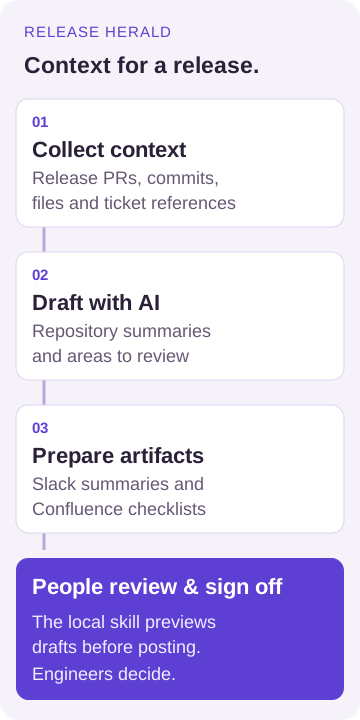
A simplified illustration of the prototype. This is a workflow diagram, not a screenshot of internal tools.
Collect the context. Draft the summary. Keep release review in human hands.
Technology stack
The tools behind the work, and where I used them.
Release context
Bash
GitHub CLI
jq
Collect release pull requests, commits, changed files, and ticket references across repositories.
Drafting & integrations
Python
Claude
Slack API
Confluence REST API
Turn collected context into summaries and create or update release checklists.
Developer workflow
Agent skill
GitHub Actions
Run release preparation locally with a draft preview, or trigger the prototype from a release pull request.
Selected contributions
Bring release context together
Problem
Release preparation pulled information from multiple repositories. Each needed its own scope, change list, and ticket references.
My contribution
I wrote the collection scripts and connected their output to a summary-generation step, keeping the context grouped by repository.
Decision
Collect structured source data before asking the model to summarize it. Handle repositories without an active release explicitly.
Value delivered
The prototype produces repository-specific drafts from collected changes, giving reviewers a starting point without assembling the context by hand.
Bash
GitHub CLI
jq
Python
Claude
Make checklists reusable
Problem
A release document needs fresh version details and room for human checks. Running preparation again should not append the same repository summary twice.
My contribution
I built the Confluence integration to create or update a checklist for a release version, replace each repository’s generated block, and preserve the manual checklist structure.
Decision
Separate generated release context from the checks engineers still need to perform. Reuse the existing checklist format.
Value delivered
Reviewers get updated release context in a familiar document, with repository blocks replaced on reruns and manual signoff kept in the workflow.
Python
Confluence REST API
Put the prototype into a developer workflow
Problem
A useful automation needs a practical way to run it and deliver its output where the team already works.
My contribution
I packaged a local agent skill with draft preview, connected Slack summaries to release checklists, and implemented a reusable GitHub Actions entry point.
Decision
Validate the automated path in a test environment. In the local skill, show the draft before posting; leave release decisions to engineers.
Value delivered
I demonstrated the working prototype to the team and validated an automated trigger on one repository. The result was a concrete workflow the team could evaluate.
Agent skill
GitHub Actions
Slack API
Python
Engineering decisions
AI drafts; engineers decide
Summaries help people review a release. They do not replace source changes, testing, or human signoff.
Meet the team where it works
Deliver summaries in Slack and checklists in Confluence, instead of asking people to adopt another dashboard.
Prove the workflow first
Start with a working prototype and a tested trigger path before treating it as a production service.
Outcome
Release Herald became a working prototype that I demonstrated to the team, with a validated automated release-trigger path. It brought multi-repository context, AI-assisted summaries, and review checklists into a single preparation flow.
Let’s compare notes.
Have a related challenge or a question about the work?